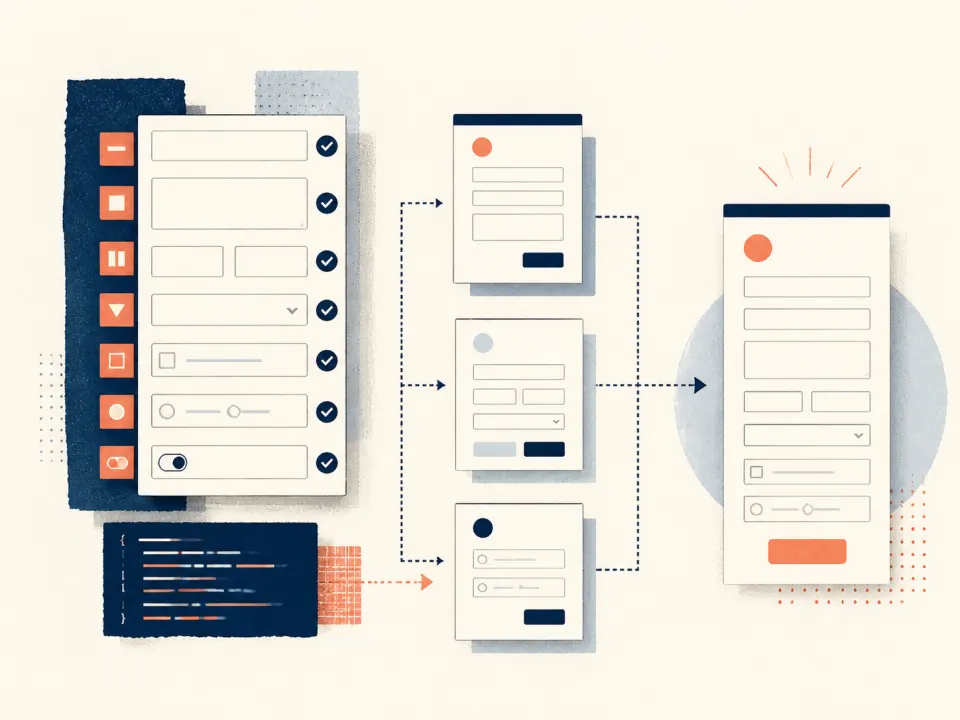
Replacing SurveyMonkey with a client-owned form platform that works on any website.
I built the form builder, the Vue-powered public embed runtime, and the submission pipeline that lets a client add a complete form to any website with one script and an <ed-form uuid=""> element.
Role
Technical Director
Context
Multi-tenant business platform
Disclosure
Client-anonymous
The problem
The problem
A client wanted to replace SurveyMonkey with an in-house form capability. The initial builder took days to shape; the hard part took weeks: delivering a reliable, fully functional form on any client website without requiring a bespoke build for every site or every form.
55M+form loads
400K+submissions
2.3M+submission fields collected
1script + HTML element to install
What I built
The system, not just the screen.
A builder that defines the whole experience
Created the form model and management experience for fields, validation, multi-page flows, styles, confirmation behavior, autoresponders, webhooks, conversion reporting, allowed domains, and internal previews. Teams can shape a workflow without handing each variation to engineering.
A tiny install with a complete runtime behind it
Built a JavaScript loader around a simple <ed-form uuid=""></ed-form> placeholder. It fetches the form definition and styling through the API, then mounts a Vue application in place of the dummy element. The result is a complete, client-configured form without asking every client site to rebuild its frontend.
A submission starts an operating workflow
Built the submission path to collect progressive context, apply multiple spam checks, verify CAPTCHA when used, create form-submission records and CRM contacts, send autoresponders and notifications, dispatch webhooks, attach conversions, and quarantine questionable traffic before it becomes downstream work.
System sketch
How the system works.
A simplified view of the system boundary and the work it moves through.
Form builder
Form details API
<ed-form uuid="">
Vue runtime
Submissions and CRM
Key decisions
Key decisions
Make the embed contract intentionally small: a script and <ed-form uuid=""> are enough to install a complete form.
Fetch form structure and styles at runtime so the same deployable Vue application can power many client-specific experiences.
Keep public form completion fast while moving notifications, verification, webhooks, CRM follow-up, and other consequential work onto the right processing path.
Use layered abuse protection—domain checks, honeypots, CAPTCHA, blocking, and quarantine—instead of trusting a single control.
What it enables
What it enables
This is not a pretty form builder with a few templates. It is a client-owned intake platform running across the web: more than 55 million form loads and 400,000 submissions so far, with the operational work behind every response built into the system.