How a team of free agents became a real team—with just enough software.
When I took over The Free Agents—a men’s slow-pitch team assembled from a players-looking-for-a-team list—I turned the whiteboard routines already helping us play better into Free Agents Softball: roster admin, league sync, RSVP, lineups, live scorekeeping, and stats in one intentionally low-friction tool.
Role
Creator and product engineer
Context
Slow-pitch softball league
Disclosure
Personal project
The problem
The problem
By the third season, our team of free agents needed more than a group text and a “show up and play” routine. A small lineup and fielding whiteboard had already made a visible difference; when I was asked to manage the team, I wanted the same practical help before, during, and after every game—without importing the full complexity of serious baseball scorekeeping.
In use
A real team tool, designed for game night.
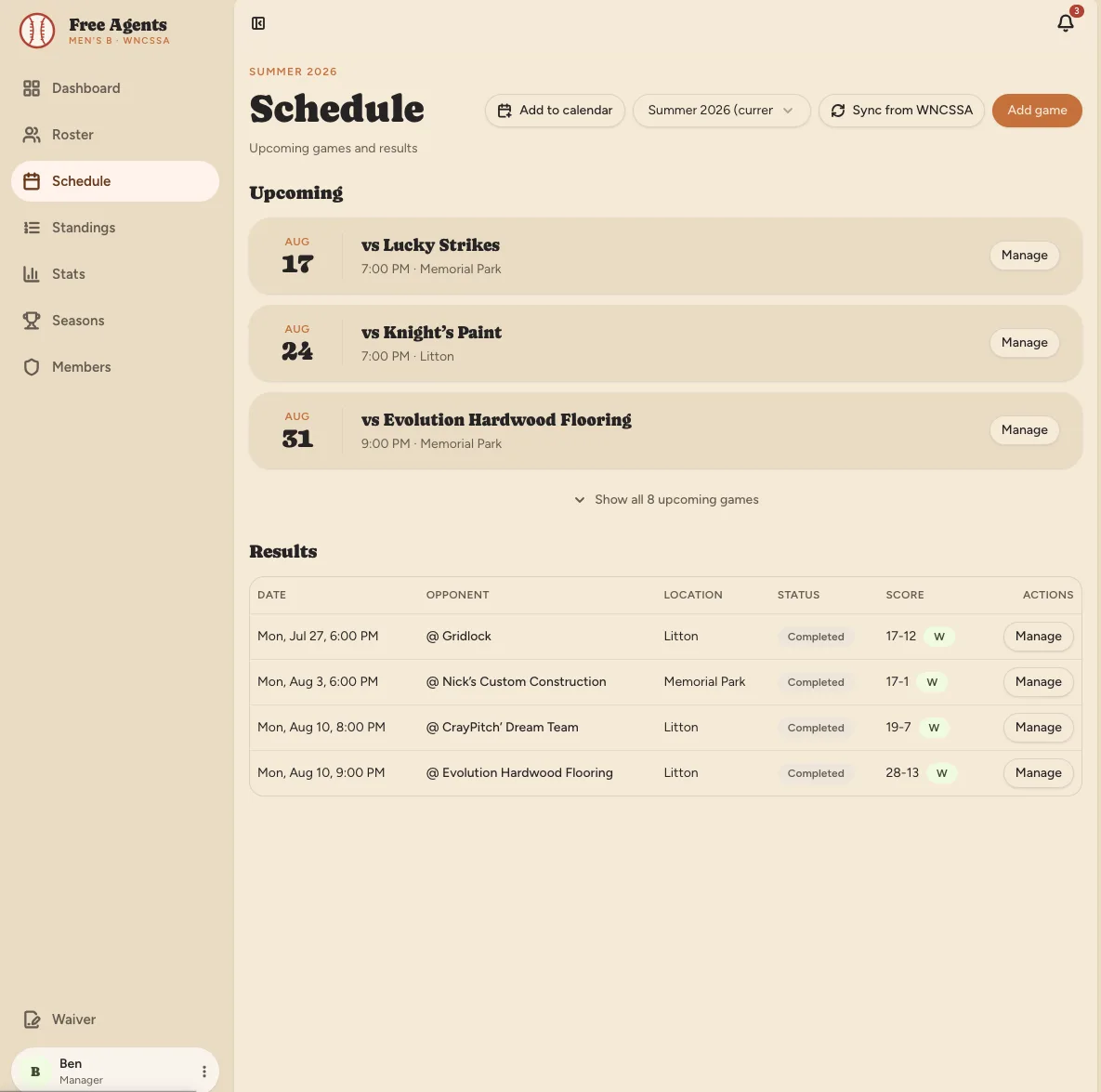
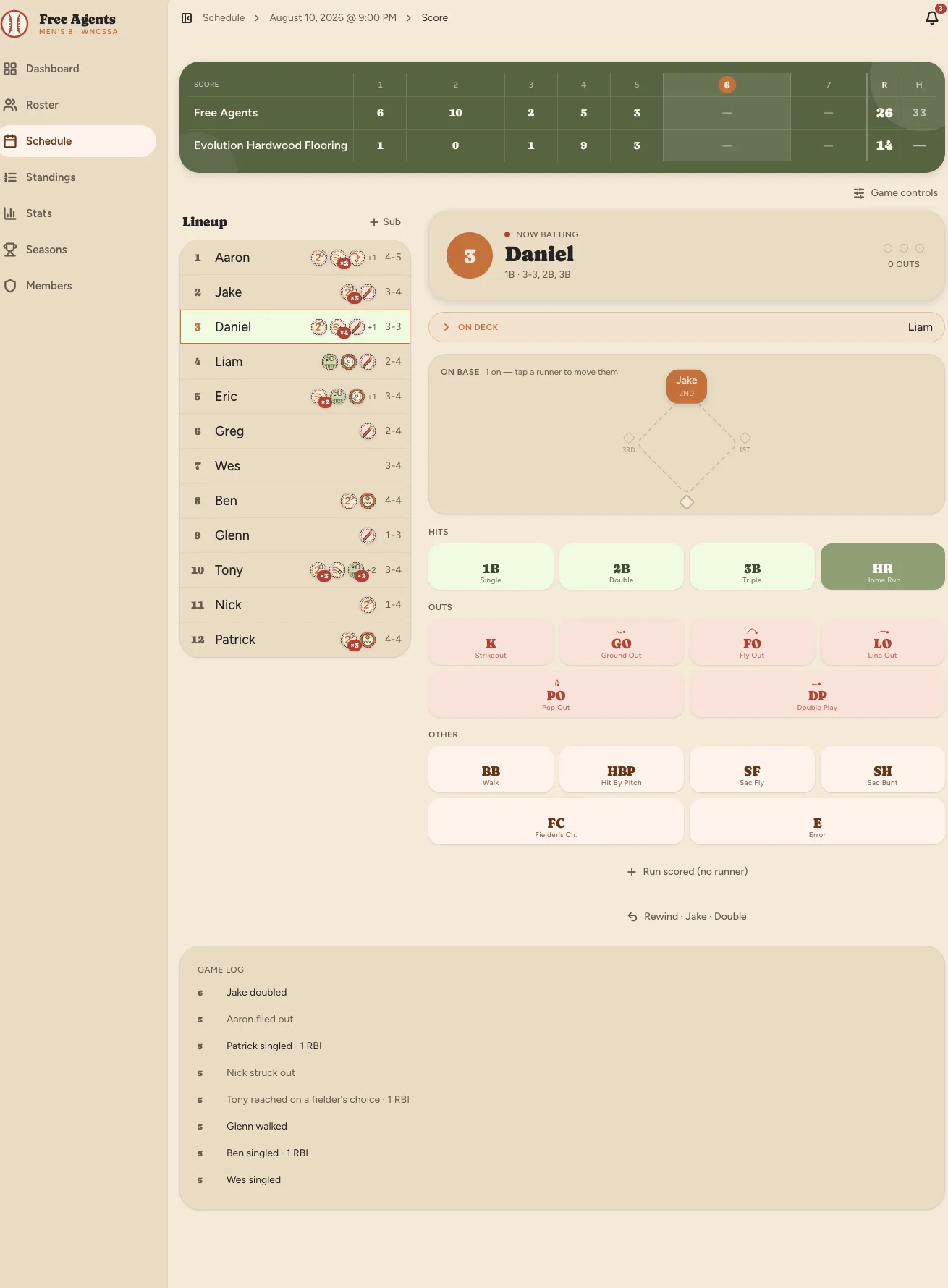
From league schedule to team calendarThe schedule pulls in league context, then becomes a place to manage games, calendar invites, and results.A scorebook made for this leagueThe active batter, runner movement, inning line, outcome controls, game log, and undo are all visible—enough context to keep score and make better decisions without a pitch-by-pitch scorecard.
What I built
The system, not just the screen.
A practical home for the unglamorous team work
Started with the information a manager actually chases down: player contact details, preferred positions, dues, waivers, availability, and a season roster. Then added shareable RSVP links and calendar feeds so game communication did not have to live in a text thread.
A league-aware game and season view
Built a schedule importer against the association’s site, then extended it to pull results and calculate standings. The team sees the next game, past results, opponent context, and its place in the season without maintaining a second set of records.
Live scoring that earns its keep
The real unlock was a field-side scorebook for innings, outs, runs, bases, at-bats, substitutions, defensive changes, and undo. It creates the player statistics needed to set better lineups from what actually happened—not just who felt hot last week.
System sketch
How the system works.
A simplified view of the system boundary and the work it moves through.
League association site
Schedule + results sync
RSVP + lineup board
Live scorebook
Stats + standings
Key decisions
Key decisions
Build around a slow-pitch team’s actual game-night sequence, from RSVP to lineup to recap, rather than a generic league administrator’s menu.
Keep the scoring model intentionally lighter than GameChanger: enough at-bat and field context for meaningful statistics, without balls, strikes, and the rest of pitch-by-pitch bookkeeping a chill league does not need.
Combine season statistics with preferred positions, availability, and practical manager judgment so a lineup suggestion is useful before the sample size is perfect.
What it enables
What it enables
Free Agents Softball turns a loose group of players into a team with shared context: less coordination by text, better game preparation, lineups grounded in real data, and a season record the whole team can enjoy revisiting.